
Table of contents
- What is GS1 Sunrise 2027?
- Is GS1 Sunrise mandatory?
- Why is the packaging industry moving beyond traditional barcodes?
- Traditional barcodes vs. GS1 2D barcodes
- What is GS1 Digital Link?
- Why GS1 Sunrise matters for packaging teams
- How to prepare for GS1 Sunrise 2027
- Common misconceptions about GS1 Sunrise
- Looking beyond 2027: What the future holds
- Key Takeaway
- GS1 Sunrise 2027 FAQs
If you’ve been hearing a lot about GS1 Sunrise 2027, you’re not alone.
For packaging teams, it seems to come up everywhere. Industry events, webinars, articles, and customer conversations all point to the same milestone. Yet despite the growing attention, there’s still plenty of confusion.
Is GS1 Sunrise a regulatory deadline? Are traditional UPC barcodes going away? Do brands need to redesign every package before 2027?
The short answer to these questions is no.
GS1 Sunrise isn’t a legal mandate or the end of the familiar barcode. Instead, it’s an industry initiative that marks an important shift toward smarter, more connected packaging. By the end of 2027, retailers worldwide are working toward being able to scan and process GS1-compliant 2D barcodes, such as QR codes powered by GS1 Digital Link, alongside today’s traditional 1D barcodes.
For brands, the initiative is about much more than changing a barcode. It’s an opportunity to improve traceability, strengthen product transparency, support evolving regulatory requirements, and create better consumer experiences using a single barcode.
So, let’s roll up our sleeves and discuss what GS1 Sunrise 2027 means, why it matters, and how packaging teams can start preparing for it today.
What is GS1 Sunrise 2027?
GS1 Sunrise 2027 is a global industry initiative led by GS1 that encourages retailers to support scanning 2D barcodes at the point of sale by the end of 2027. During the transition, those 2D barcodes will coexist with traditional UPC and EAN barcodes rather than replace them.
Unlike traditional 1D barcodes, which primarily identify a product using its Global Trade Item Number (GTIN), 2D barcodes can support significantly more information while remaining compact enough to fit on product packaging.
That additional capacity opens the door to a wide range of possibilities, including:
- Product authentication
- Expiration dates and batch information
- Recall and traceability data
- Sustainability information
- Consumer-facing product content
- Digital experiences powered by GS1 Digital Link
In other words, the barcode becomes more than a checkout tool. It becomes a gateway to trusted product information throughout the product’s lifecycle.
Is GS1 Sunrise mandatory?
This is one of the most common questions packaging professionals ask.
The answer is no.
GS1 Sunrise 2027 is not a legal mandate. Instead, it’s a global readiness milestone established by GS1 to encourage retailers, brands, solution providers, and packaging partners to prepare for widespread adoption of 2D barcodes.
That distinction matters.
The initiative doesn’t require companies to immediately replace every existing barcode, nor does it signal the end of UPC symbols. During the transition, many products will continue using both a traditional 1D barcode and a 2D barcode on the same package while retailers upgrade scanning infrastructure and brands expand their connected packaging capabilities.
Think of GS1 Sunrise as a mile marker rather than a finish line.
The organizations that begin planning now will likely find the transition much easier than those that wait until the final years before widespread adoption.
Why is the packaging industry moving beyond traditional barcodes?
For more than 50 years, the tried-and-true barcode has done exactly what it was designed to do.
It identifies products quickly and accurately at checkout.
The challenge is that today’s packaging has to do so much more.
Consumers expect immediate access to ingredient information, sustainability commitments, recycling instructions, and product stories. Regulators are introducing new requirements for transparency and traceability. Brands need more efficient ways to manage recalls, product authentication, and rapidly changing packaging information across global markets.
Traditional barcodes were never intended to carry that much information.
Enter 2D barcodes.
Rather than serving as a simple product identifier, they connect users to a wealth of digital information while still supporting retail checkout. The result is one barcode that acts as a workhorse, supporting multiple business needs in lieu of having separate codes for different purposes.
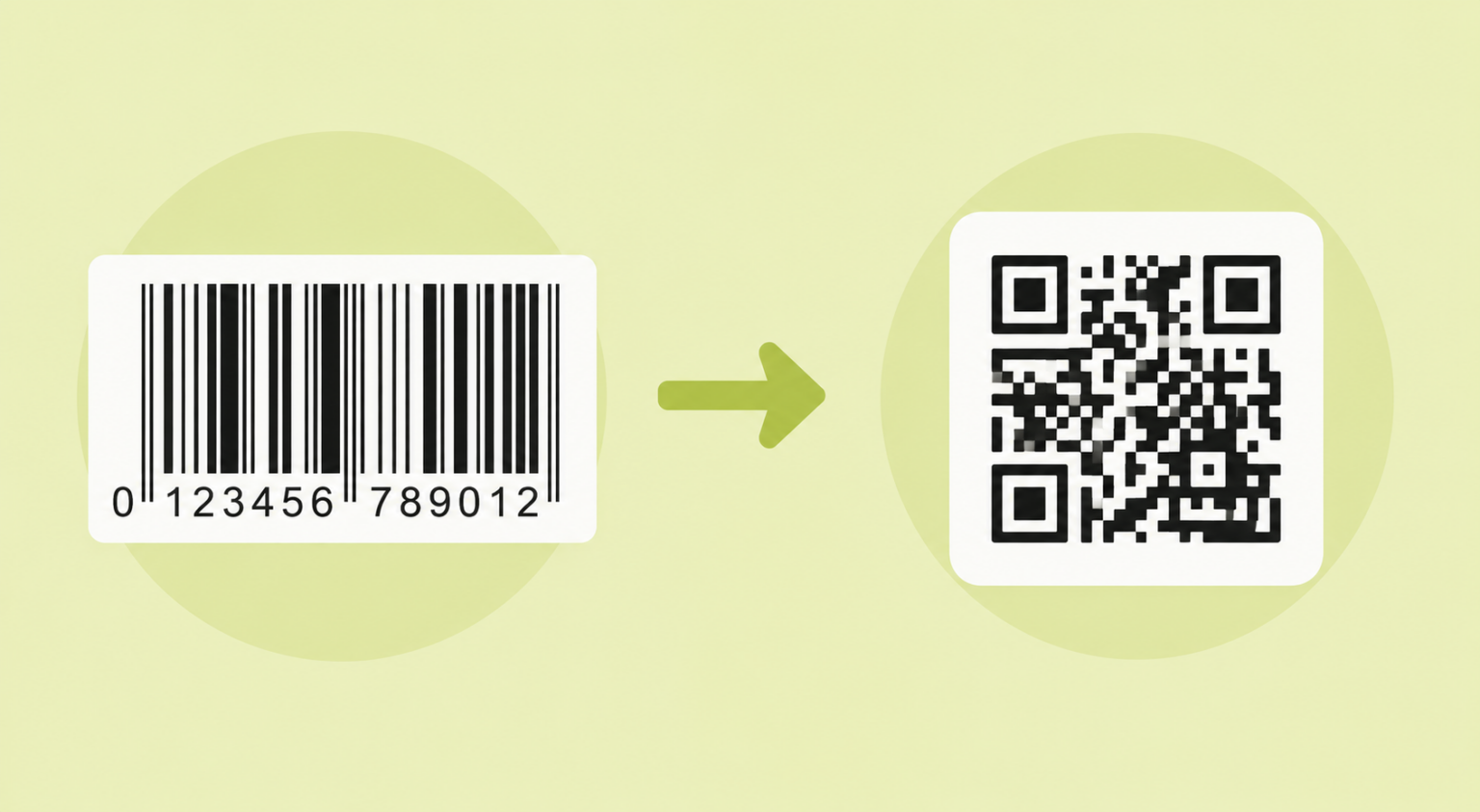
Traditional barcodes vs. GS1 2D barcodes
Surprisingly, the barcode itself isn’t the biggest change.
The eye opener is what goes on behind it.
What is GS1 Digital Link?
As discussions about GS1 Sunrise continue, you’ll often hear another term mentioned alongside it: GS1 Digital Link.
They’re closely related, but they’re not the same thing.
Think of GS1 Sunrise as the industry initiative driving adoption of 2D barcodes.
GS1 Digital Link is one of the standards that allows those barcodes to connect physical products with digital information.
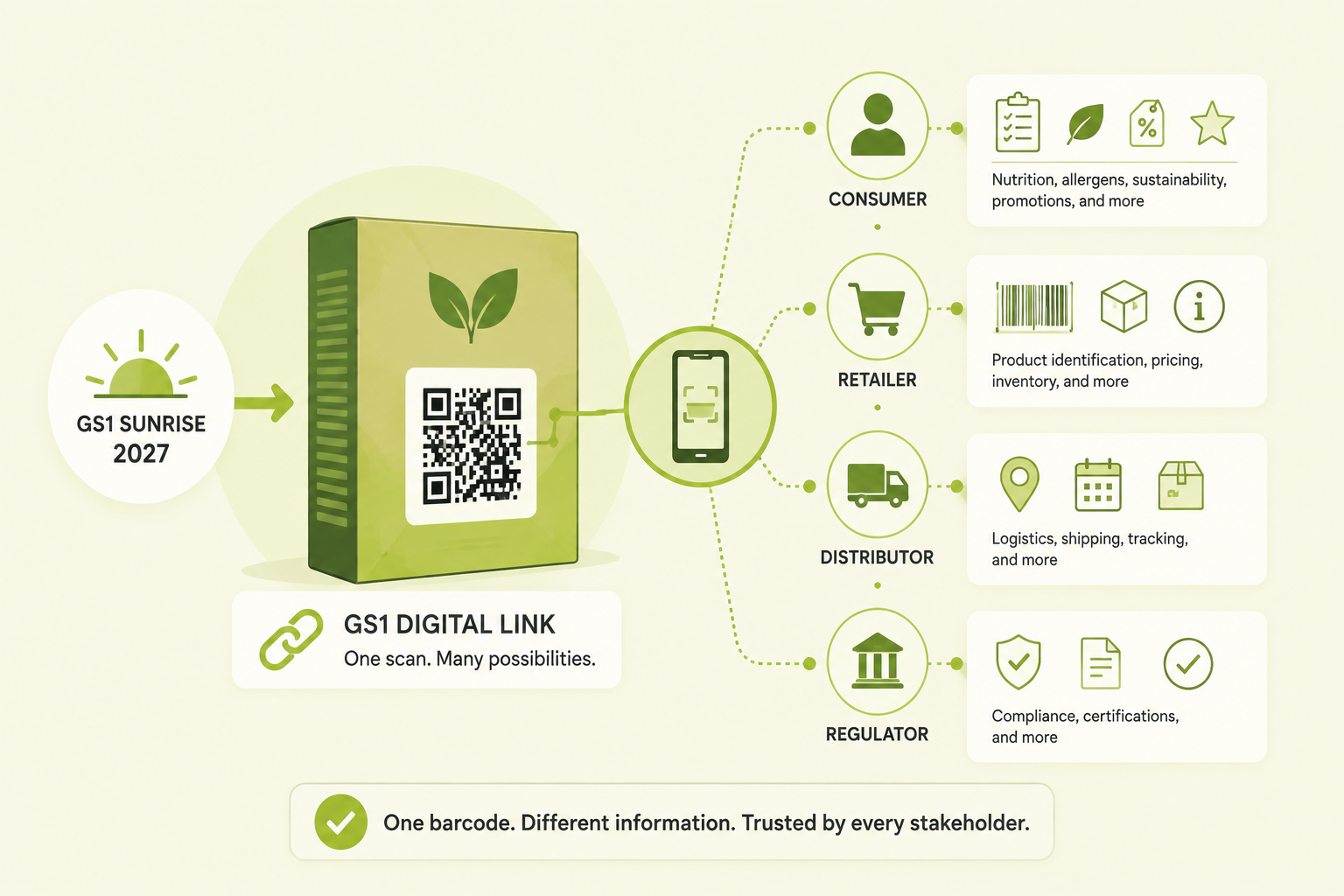
When someone scans a GS1 Digital Link-enabled QR code, the information they’re directed to may vary depending on who they are and why they’re scanning.
A consumer might see nutritional information, allergen details, sustainability commitments, or promotional content.
A retailer might access product identification data.
A distributor could retrieve logistics information.
A regulator might verify compliance data.
The important point is that the product only needs one barcode to support these different troves of information.
That creates exciting opportunities for connected packaging, but it also raises the stakes for packaging teams. The information linked to that barcode must remain accurate, approved, and consistent across every product variation and market where it’s used.
Why GS1 Sunrise matters for packaging teams
GS1 Sunrise is so much more than just a barcode initiative.
In fact, it touches almost every part of the packaging process.
Adding a new 2D barcode is simple.
The challenge is ensuring the information behind that barcode is correct.
That means coordinating approved copy, regulatory content, marketing claims, product data, artwork, translations, and version control across potentially hundreds or thousands of SKUs.
For example, a change to an ingredient list might require updates to artwork, nutritional information, digital product content, approval workflows, and print files.
Multiply that across dozens of markets, languages, and product variants, and it becomes clear that GS1 Sunrise isn’t just about changing packaging.
It’s about managing packaging data more effectively.
Packaging teams that already have strong artwork management, content governance, and approval processes will likely find the transition much smoother than organizations relying on disconnected spreadsheets, email approvals, and manual version tracking. Platforms like WebCenter, which centralize artwork, approvals, and version control, can help establish a single source of truth as packaging complexity grows.
How to prepare for GS1 Sunrise 2027
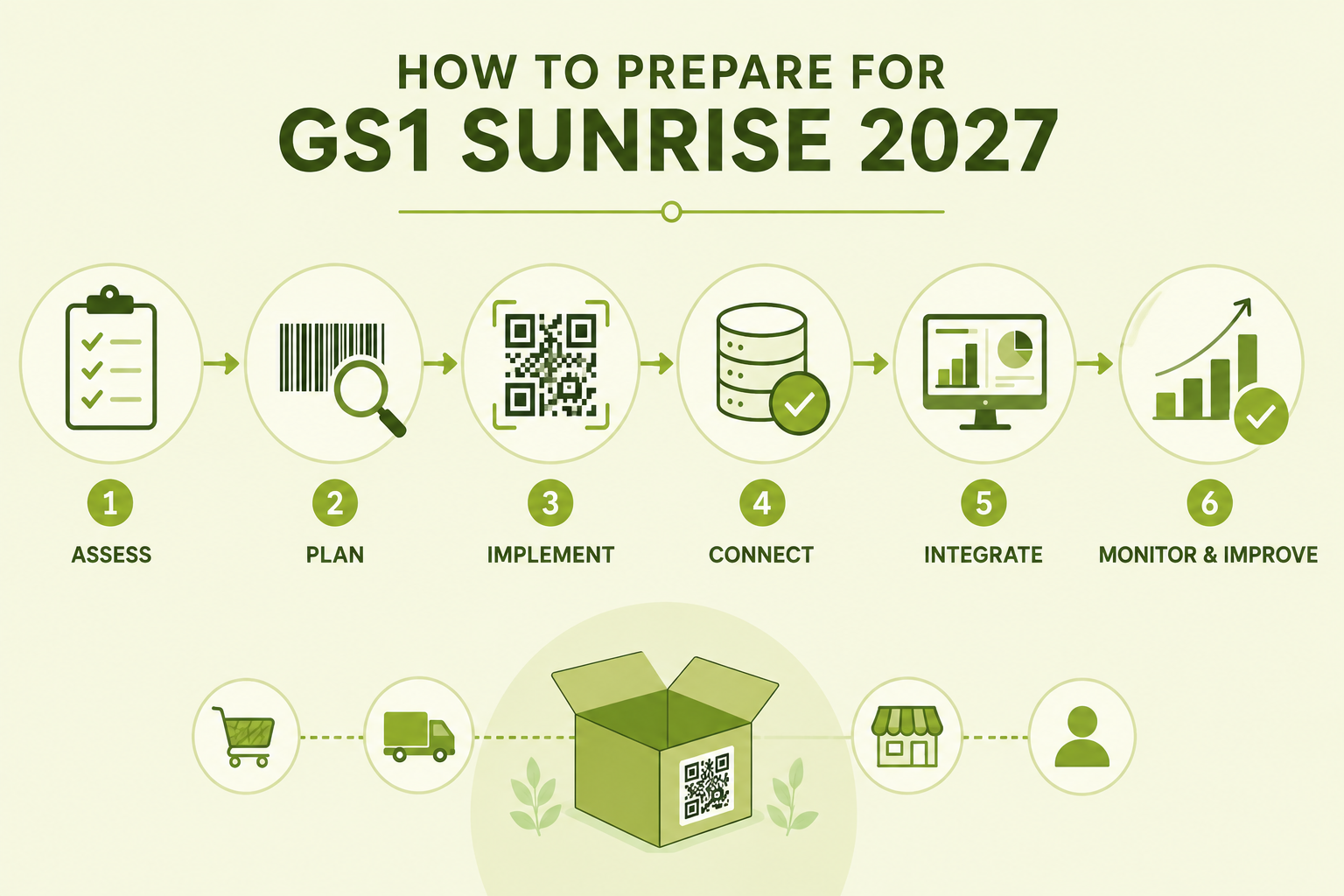
If GS1 Sunrise 2027 is making you feel overwhelmed, don’t worry. You don’t have to overhaul your packaging operations immediately. A phased approach allows brands to build the processes they’ll need as 2027 approaches.
Here are 5 key steps to help you get started:
Review your current packaging portfolio
Start by understanding where your products stand today.
Which products already use QR codes? Which still rely solely on traditional UPC or EAN barcodes? Do you have product lines that would benefit from better traceability, consumer engagement, or improved access to product information?
Many organizations implement a pilot program before adopting the initiative across their full portfolio.
If you’re still deciding where to start, our guide to 2D traceability in packaging provides a helpful overview of how brands are approaching the transition.
Focus on the data, not just the barcode
Imagine a food manufacturer decides to reformulate one of its best-selling products to remove an allergen.
At first, it sounds like a simple product update.
In reality, it triggers a series of packaging changes.
The ingredient list changes. The nutrition panel must be updated. Regulatory teams review the new information. Marketing verifies on-pack claims. Packaging artwork is revised, translated, approved, and prepared for print. If the product is sold globally, those updates may need to be repeated across multiple markets.
Now envision that the same package includes a GS1 Digital Link-enabled barcode.
The digital information connected to that barcode also needs to stay accurate and aligned with the approved packaging.
This is where GS1 Sunrise 2027 comes into focus. The initiative encourages organizations to manage product information more consistently throughout the packaging lifecycle.
Strengthen artwork and approval workflows
As packaging becomes more connected, artwork management becomes even more important.
Consider a situation where marketing is refreshing packaging graphics while regulatory is updating ingredients and a retailer requests revised product information.
Without a structured approval process, outdated copy, incorrect claims, or even the wrong barcode can easily make their way into production.
Reviewing artwork workflows now helps reduce those risks later so they don’t become costly mistakes.
Organizations looking to improve how packaging content flows between systems may also find value in exploring artwork management integration across PLM, PIM, ERP, and other business systems.
Design packaging with 2D barcodes in mind
Finding space for a new barcode isn’t always as simple as it sounds.
Barcode placement is often considered during artwork creation, and tools such as DeskPack can help designers create GS1-compliant 1D and 2D barcodes directly within Adobe Illustrator.
Barcode placement, size, quiet zones, color contrast, and print method all influence how reliably a code can be scanned.
Making those decisions early, alongside packaging designers, prepress specialists, and print partners, helps avoid unnecessary redesigns later in the process.
Validate before products reach the shelf
Successfully generating a barcode is only part of the process.
It also needs to perform consistently in the real world.
Testing should confirm that the barcode scans reliably across retail environments while meeting print quality requirements throughout production. Solutions like DeskPack Packaging Preflight can automatically verify packaging files before production, helping identify issues such as missing or incorrect barcodes before they become costly print errors.
Taking time to validate packaging before launch helps reduce the risk of production delays, scanning issues, and expensive reprints.
Common misconceptions about GS1 Sunrise
Like many industry initiatives, GS1 Sunrise has sparked more than a few misconceptions, including:
“Traditional UPC barcodes will disappear in 2027.”
Not quite.
For the foreseeable future, traditional 1D barcodes and 2D barcodes are expected to coexist while retailers continue upgrading their systems. Many brands will use both symbols on packaging during the transition.
“GS1 Sunrise is just another compliance project.”
Compliance certainly plays a role, but that’s only part of the story.
The same barcode that supports retail checkout can also improve traceability, provide consumers with richer product information, simplify recalls, and support connected packaging initiatives.
“Adding the barcode is the hardest part.”
For most packaging teams, the opposite is true.
Generating the barcode is relatively simple.
Managing the information behind it across hundreds of SKUs, multiple markets, and changing regulations is where the real work begins.
Looking beyond 2027: What the future holds
Although GS1 Sunrise focuses on retail readiness in 2027, it represents a much broader shift in packaging.
Consumers increasingly expect immediate access to trustworthy product information.
Regulators continue introducing new transparency requirements.
Brands are looking for ways to connect physical packaging with digital experiences while improving supply chain visibility.
GS1 Sunrise helps lay the foundation for that future.
It’s also one of the reasons discussions around Digital Product Passports, connected packaging, and product transparency have accelerated in recent years. While these initiatives each have different objectives, they all depend on accurate, well-managed product information.
If you’re exploring connected packaging strategies, you may also be interested in how GS1 Digital Link is helping brands scale connected packaging experiences.
Key Takeaway
Whether you’re launching a new product, reformulating an existing one, expanding into a new market, or preparing for future initiatives like Digital Product Passports, the challenge is making sure the right information reaches the right people at the right time.
That’s what makes GS1 Sunrise so much more than just a barcode initiative.
It’s an opportunity to build stronger packaging processes, improve how product information is managed, and prepare for a future where packaging plays an even greater role in connecting brands, retailers, regulators, and consumers.
Organizations that start preparing today will be better positioned for whatever comes next.
GS1 Sunrise 2027 FAQs
Do I need to replace all of my existing barcodes before 2027?
No. Most organizations are expected to use both traditional 1D barcodes and GS1-compliant 2D barcodes during the transition. The pace of adoption will vary as retailers upgrade their point-of-sale systems.
Can I use one barcode for both retail checkout and consumer engagement?
Yes. GS1-compliant 2D barcodes powered by standards such as GS1 Digital Link can support retail scanning while also connecting users to product information, sustainability content, recalls, promotions, and other digital experiences.
Will GS1 Sunrise affect my packaging artwork?
Yes. While adding a 2D barcode may seem straightforward, packaging teams also need to consider barcode placement, artwork updates, approval workflows, print quality, and the accuracy of the product information linked to the barcode.